AI Doesn't Have a Memory Problem.
Humans Have a Clarity Problem.

What three years of obsessive daily AI use taught a non-coder about architecture, data, and building things that actually work.

I replaced 200 lines of Python with one sentence: "Sort these tasks by consequence — most urgent at the top."

I had a scoring engine — detailed logic telling AI exactly how to rank my 60 open business tasks. Step by step, rule by rule, weight by weight. It produced 25 "fires" out of 60. When everything's a fire, nothing is.

I scrapped it. Gave a smarter model that one sentence and the same data. Five fires. Twelve for today. Four for later. Exactly how I'd plan my day if I thought through every task myself.

Notice what's missing. I'm not assigning weights. I'm not explaining that task A matters more than task B. I'm not telling it how to think — I'm telling it what I want. And it already understands the rest. My business, my industry, the consequences of dropping the ball on different things. Not because I explained all of that in the prompt — but because I've given it clean, maintained documents that load up at the start of every session. None of them say "this task is most important." They give AI enough clarity about the details and the greater context that it can reason on its own.

I haven't written code since learning BASIC in the mid-80s. I built that scoring engine with an AI coding tool, and then I watched it get beaten by clarity.

That's what this whole piece is about. And if you're spending your energy writing better prompts, choosing better models, or building more sophisticated agent frameworks — you might be optimizing the wrong layer.


How I got here

I'm a small business owner with ADHD. Not a developer. I treated AI like a really smart friend from day one and spent three years extracting truth from it.

I learned something from writing books that turned out to apply to everything: when you're building a manuscript, you start with a thesis, then claims, then research. You create foundational documents. But as you go further, earlier artifacts have to be quarantined — they pull you away from your focus. You need extreme clarity at each stage, with noise quarantined so it can't contaminate the signal. That same discipline applies to AI.

The clarity principles — north star documents, trust hierarchy, modular structure — I've had those for a while. What I couldn't crack was making everything talk to each other. Getting AI to write to my files. Building real software that runs on its own.

I've been playing with AI coding tools for a couple of years. Hit walls, learned more each time. Recently, something converged — the tech got good enough to compensate for my weaknesses, and I'd learned enough about process to use it right. In a couple of weeks I built a full production system: communication triage across every channel, daily intelligence reports, a 24/7 assistant bot, proactive alerts, self-learning business rules. All running. All connected.

But the infrastructure only worked because the principles were already in place.

The framing: words are code

A developer would never ship a codebase with 15,000 lines of dead functions, outdated comments, and unverified dependencies. But that's exactly what most people do with their AI inputs.

Your files are a codebase. Every document AI has access to is an instruction it's executing against. Every memory, every email, every file in your Drive — it's all code. Every unnecessary piece is noise competing against signal.

Clarity versus noise. Every unnecessary input degrades the output — and you won't notice. The results just get quietly worse. You'll blame the model. And the whole time you're making decisions based on those degraded outputs without realizing the inputs were the problem.

You think you need a bigger context window. You don't. You need less garbage in the one you have.

More capacity just means more noise processed with more confidence.

Use
Strategize
Build
"You are all three. That's the compounding advantage."

Outsourcing the building kills the iteration speed. The person using the system, strategizing about it, and building it — when that's the same person, the feedback loop is instant.

The principles

1. Build a trust hierarchy into your data

My Google Drive had 15,135 files. I spent a day with AI triaging every one. Reduced it to 2,453 — less than a hundred at root level. That's my clean, verified truth. The rest live in Resource Bank subfolders where AI knows they're potentially noisy.

Where a file lives tells AI how much to believe it. Location equals trust.

If you don't control this, AI will treat a brainstorm from two years ago with the same authority as your current strategy — and you'll never know, because the output reads just as polished either way.

Every file gets tracked in a master inventory with properties: what it's about, which areas of my life it touches, its trust level. Any AI can look at that one place and understand the whole architecture.

Don't be afraid to kill things. If you build something better, the old version just became noise. With AI, rebuilding isn't expensive. I've deleted entire systems and started fresh when the new approach was cleaner.

2. Build north star documents for every domain of your life

One of the first things I did with AI was record about seven hours of myself talking and upload the transcripts. I said: "Find the patterns hidden from me. Give me the top five things where I'm probably unaware of them, knowing them would have a significant positive impact, and they're highly likely true based on what you know about human behavior."

Three criteria. No instructions on how to process the data. Clear input, clear desired output, let AI think. The results were unsettling in their accuracy.

That became a dense document — a Psychological Blueprint. When I hand AI that document and say "I'm having this struggle, what am I missing?" — and push it hard, because it'll just stroke you if you let it — the results are extraordinary.

I built more of these for every domain. The key is modularization — layers. Overview documents that orient any AI instantly, detailed documents underneath for when a conversation goes deep. How you divide things up is your call. The principle: give AI what it needs at the right level of detail.

These are constitutions, not daily notes. They only change when something substantive shifts. AI reads my environment document and recommends furniture and decor I genuinely love — things I didn't pick out. That's what clean, maintained data produces.

3. Be intentional about what AI remembers

I turned off built-in memory on every AI platform. Not because I'm anti-memory — because I want to control it.

When I didn't: I'd play devil's advocate on a political topic, and suddenly AI injected that framing into conversations about my tech stack. Letting AI decide what matters about your life is outsourcing judgment to something with no context.

My entire ecosystem IS the memory. Every file, every canonical document, every change log — a connected network that any AI plugs into fresh. At the end of every significant conversation, me and AI decide together what's worth keeping. Next session starts from current truth.

My brain lives in my files, not inside any AI platform. Switch providers tomorrow, lose nothing.

4. Clear inputs, clear desired outputs — let AI figure out the rest

Over three years I've stripped away almost all the detailed prompts and decision trees I used to write. As models get smarter, detailed instructions become noise — they constrain reasoning instead of enabling it. The scoring engine proved it.

If your prompts are getting longer and more complicated, you're trying to fix bad thinking with more words.

Fix the inputs. Simplify the ask. Trust the model.

5. Everything talks to each other through one hub

I used to have fifteen individual AI projects that couldn't see each other. Full-time job just moving information around.

The breakthrough was putting everything in one hub where every AI can read and write. Then I built a custom operating system for each role: one for AI coordination, one for me, one for each team member, one for each AI tool. The thinking AI gets strategy context. The building AI gets technical specs. The assistant bot gets operational data. Same underlying information, completely different interfaces — each one designed for exactly what that person or AI needs.

All connected. When something changes, everything that needs to know sees it.

🧠

Clear Internal Signal

North stars, psychological blueprint, constitutions. Your truth, maintained and current.

The LLM

The reasoning engine. Powerful — but only as good as what you feed it.

🌐

Clear External Signal

Business data, communications, files. Organized, verified, trust-tagged.

A second brain without an LLM is a filing cabinet.
An LLM without clean data is a hallucination machine.

What it actually feels like

I leave a mess behind me. I always have. I download files and forget where I put them. I take notes in Notepad and forget I made them. I can't remember if I read something in an email, a text, a Google Doc, or a Notion page.

Now I don't have to care. Scripts run overnight and bring order to all of it.

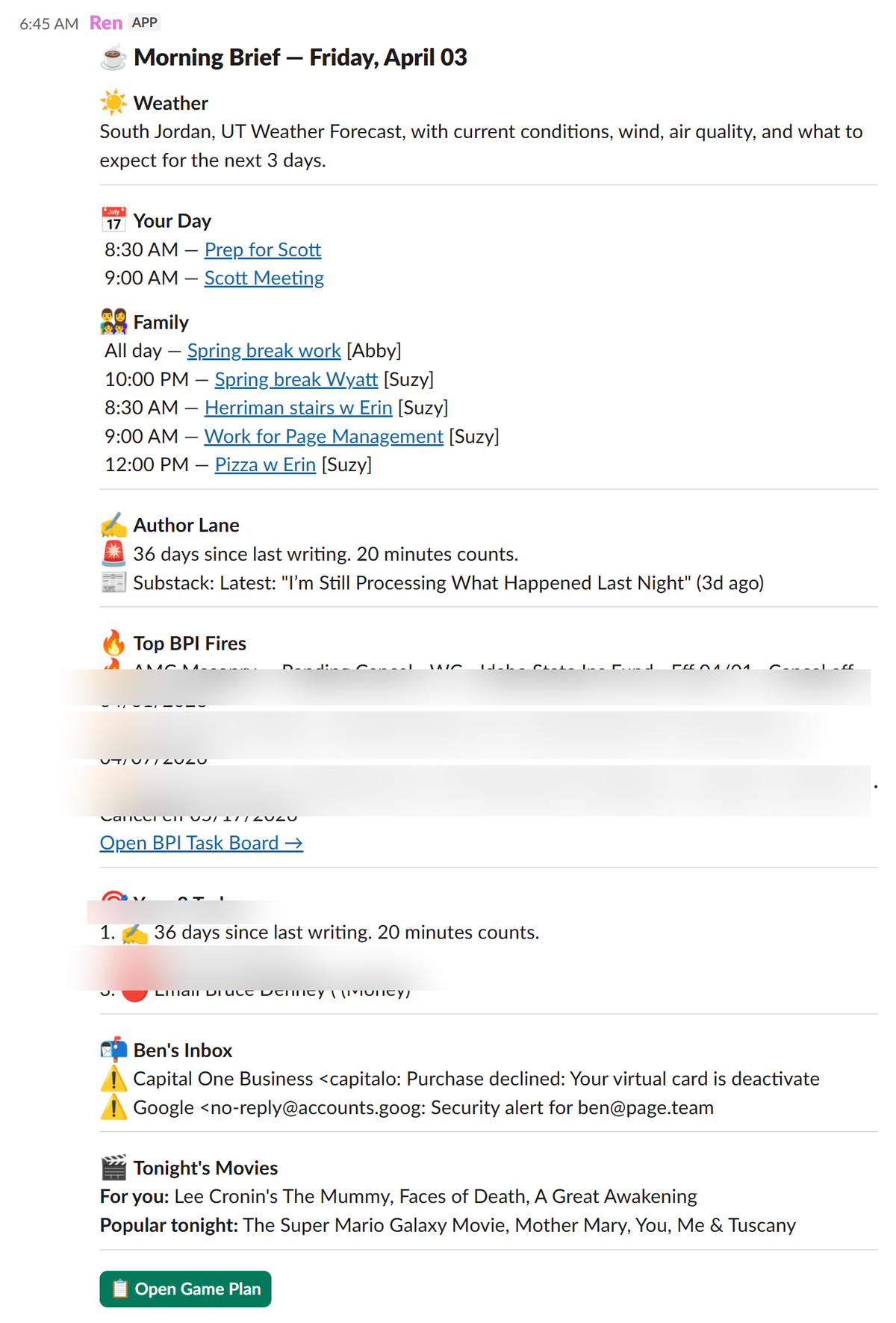
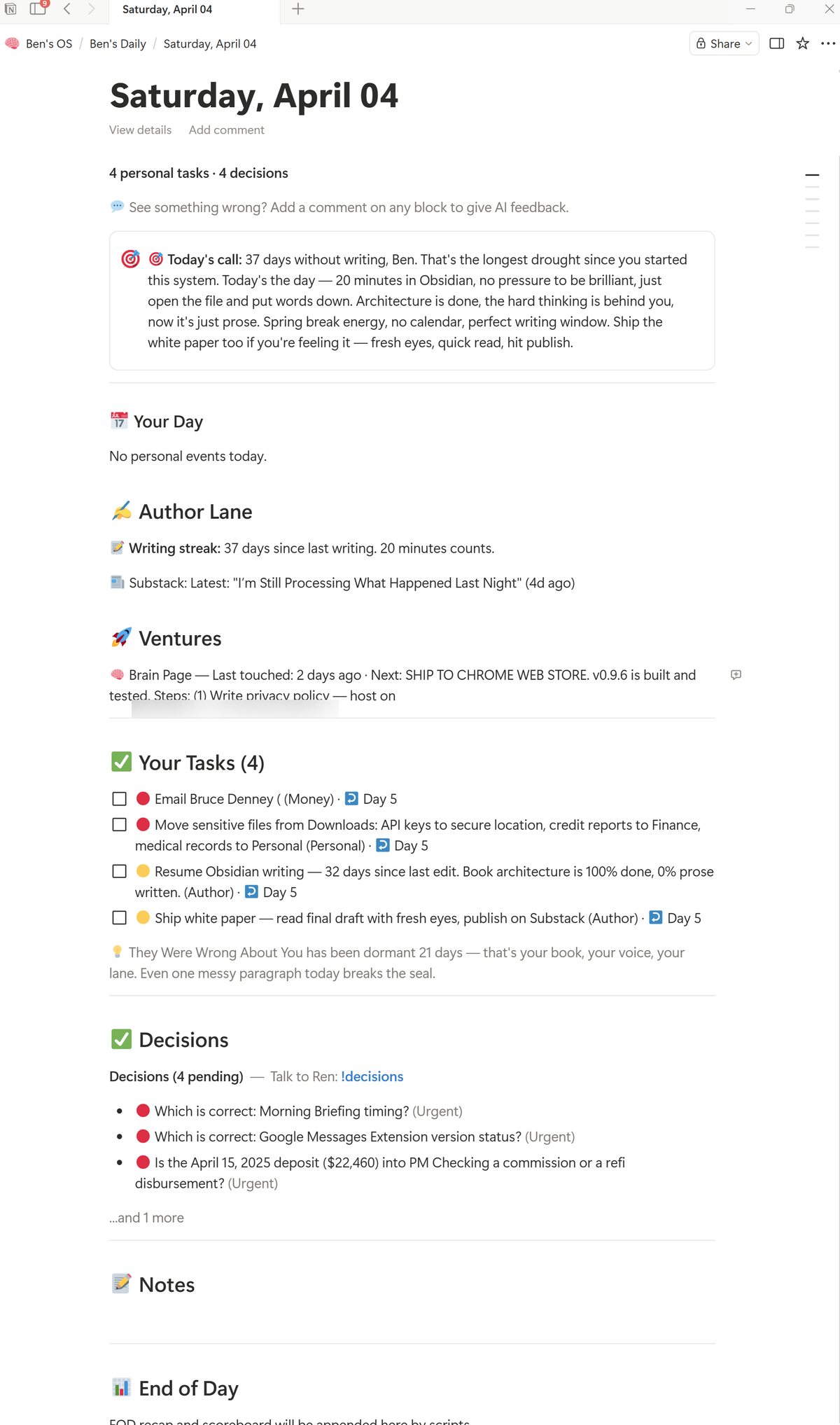
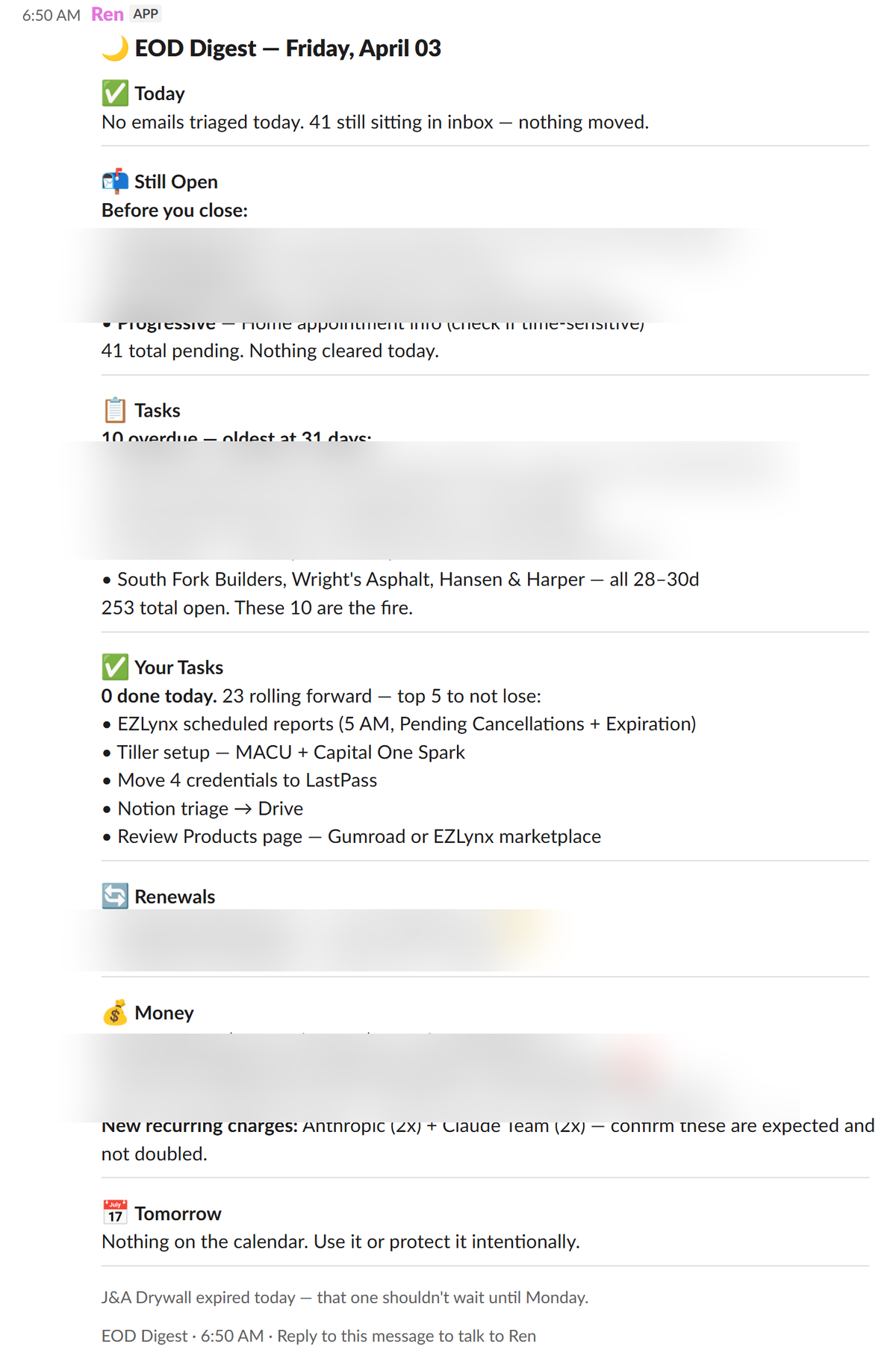
The system has a circadian rhythm. It wakes up before I do. 2 AM: file inventory refresh. 3 AM: discrepancy scanner checks whether documents agree with each other. 5:30 AM: the most powerful model available reads my open tasks, calendar, pending decisions, Slack messages from last night, even how many days since I last wrote in my book manuscript — generates a prioritized daily page. 6:15: morning briefing hits my phone. All day: email triage every 10 minutes, texts hourly, calls every 10 minutes. 7 PM: end-of-day digest. By the time I open my eyes, the system has already told me what matters today.

If it's not surfaced, it doesn't exist.

If your system requires someone to remember to check something, that system will fail. Everything pushed to the right person at the right time.

What's going on?

Communications, alerts, what happened while you slept

What do I do today?

Prioritized tasks, calendar, deadlines, fires

What's the bigger picture?

North stars, roadmap, where everything is heading

Where do I do the work?

Handoffs, specs, the actual building interface

The tools are interchangeable. The visibility is not.

How I actually build

There's a popular idea right now — tools where you just talk to AI and it figures everything out. I think that's a disaster. No separation between thinking and building. You end up with a mess that breaks the moment you change anything.

I have three modes: deciding, building, and using.

Deciding: I load the thinking AI with my System Manifest, Change Log, Build Roadmap, and relevant files. FIRST. Then we think together — strategy, not code. We produce a spec and write it to a handoff page.

Building: The coding AI reads the handoff page and builds. I test fast, iterate, and when it's right we close out: audit the build, write a completion report, update the Change Log and Manifest.

Using: The rest of the time, I'm just a user. When I notice something — "you never need to ask me this again" or "add this to the build queue" — I feed it back. Not triage — improvement. It never stops.

Three patterns will kill you if you don't name them. Overbuilding — designing elaborate systems instead of shipping. Flood — starting twelve things because everything feels urgent. Curating — organizing instead of executing. I fall into all three. My AI catches them too — because it knows my patterns, it can say "you're flooding right now, pick one thing."

The two AIs coordinate through documents, not shared context. Specs on handoff pages. Completion reports with rollback plans. Disagreements written down. Full paper trail.

The human rides the edge. AI does the maintenance.

Human Edge

  • Growth decisions
  • Creative direction
  • Relationship judgment
  • Building new things
  • Pattern recognition

AI Maintenance

  • File organization
  • Communication triage
  • Discrepancy scanning
  • Self-learning rules
  • Contradiction audits

Every correction becomes a rule. Every manual task is a design failure.

The infrastructure

Skip any of these and you'll build fast for a week and spend a month untangling the mess.

Without a System Manifest — a single document listing every running script, task, integration, and configuration — one build breaks another and you don't discover it until something fails silently.

Without a Change Log — every change timestamped and signed by which AI made it — something breaks and you're guessing.

Without a Build Roadmap — what's done, what's next, what's deferred — you lose track of where you are. With ADHD, this is everything.

Without Build Handoffs — one page per build, spec on top, completion report on bottom — you have no paper trail and no coordination between AIs.

Without a Decision Queue — where any system can flag what needs human judgment — the system drifts without your knowledge. Every decision is an opportunity to make it permanently smarter: "Build it into the rules."

The operating philosophy: the human rides the edge — growth, building, decisions. AI does the maintenance. Every manual task is a design failure.

Self-learning rules. When AI makes mistakes on real work, we log what went wrong. Learnings get promoted to shared rules that multiple projects read at session start. The system also watches human behavior — when someone re-labels something AI mislabeled, the system detects the correction and adjusts. AI gets better by watching what we actually do.

A Contradiction Audit. A script runs every night comparing canonical documents for disagreements. First run found 15 contradictions. Now it runs automatically — the system checks whether its own understanding of itself is still true.

The glue: one master page every AI reads first. Every thinking session, coding session, and bot points here. Who I am, where everything lives, the rules, current priorities. The AIs keep everything organized — they follow the process, update the Manifest, log changes, flag decisions. I'm not maintaining the system.

The system maintains itself.

Six documents that hold everything together. Skip one and you'll feel it within a week.

01

Master Page

The single page every AI reads first. Who you are, where everything lives, the rules.

02

North Stars

Dense constitution documents for every domain. Updated only when something real changes.

03

System Manifest

Every running script, task, integration, and configuration. The single source of system truth.

04

Change Log

Every change timestamped and signed. When something breaks, you know exactly when and why.

05

Build Handoffs

One page per build. Spec on top, completion report on bottom. Full coordination trail.

06

Decision Queue

Where any system flags what needs human judgment. Every decision becomes a permanent rule.

Described by role, not brand name. The tools are interchangeable — the architecture is not.

Hub

AI-writable workspace

One place AI can read AND write. Read-only hubs die the moment you get busy.

Vault

File storage

Root = truth. Resource Bank = everything else. Location equals trust.

Thinker

Thinking model

Strategy, planning, specs. Never code. Produces handoffs, not implementations.

Builder

Building tool

Reads handoff, builds, tests, closes out. Separate from the thinking.

Surface

Daily dashboard

Pushes what matters. If it's not surfaced, it doesn't exist.

Glue

Scripting language

Connects everything. Runs overnight. The circadian rhythm of the system.

01

Record yourself talking

A few hours. Transcribe. Upload to AI: "Find the patterns I'm not seeing." Two pages max. That's your seed.

02

Build your north star documents

Current State overview first. Then one per major domain. Dense, maintained, updated only when something real changes.

03

Clean your files

Root level = truth. Resource Bank = everything else. If you skip this step, you'll build an impressive system that processes garbage.

04

Pick a hub AI can write to

If AI can't update your documents, you're back to manually maintaining everything. Read-only hubs die the moment you get busy.

05

Take control of your memory

Turn off built-in AI memory. At the end of every significant conversation, decide with AI what's worth keeping.

06

Start building

Thinking model for strategy, coding tool for building. Keep them separate. Document everything. Ship something small that works, then iterate.

The trap: Overbuilding, flooding, curating. Pick one thing and ship it.

What this adds up to

Everyone's working memory is limited. You're running multiple projects, tools, relationships, priorities. Most people can fake it — until things start falling through the cracks. I couldn't fake it. ADHD forced me to externalize everything — and that forced discipline turned out to be exactly what AI needs.

Build your system as if no one will remember anything. If it depends on a human remembering to check something — that's not a workflow, that's a prayer.

Automated memory systems are getting better. But is automation ever going to produce something as powerful as a document about yourself that you've refined over two years? I don't think it gets you there. It's the difference between indexing your thoughts and actually understanding who you are.

The system does the work. Every day it gets easier. It's not discipline — it's architecture. And honestly? It's a pleasure.

Until you see that, you'll keep upgrading tools while the underlying problem compounds.

You don't have an AI problem. You have a clarity problem. Better models won't save you. More features won't save you.

A bigger context window is just a bigger room to fill with noise.

Start with one document. Start with clean data. Start with clarity. Everything else follows.

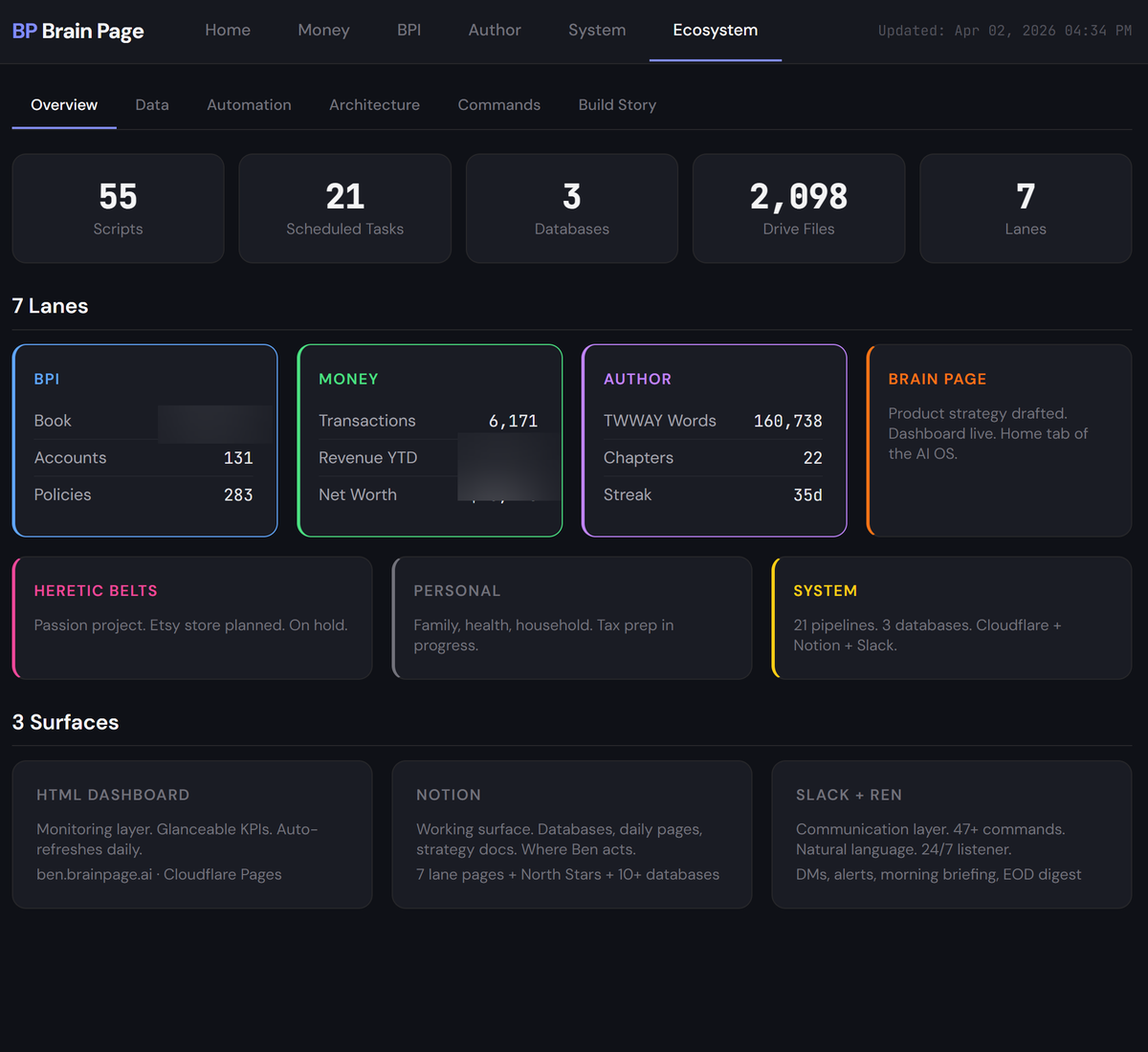
Every area of life runs through the same architecture.

BPI Author Money Brain Page Heretic Belts Personal System